
Zixing Jia
Physics x Neuroscience x AI
I am an undergraduate student at Sun Yat-sen University (Class of 2027), majoring in Physics with a strong interdisciplinary focus on brain-inspired computation and neuro-AI systems. I have been admitted to the PhD program at the Academy for Advanced Interdisciplinary Studies (AAIS), Peking University. My background spans optical interferometry, deep learning, and computational neuroscience.
I am currently a research intern at the Chinese Institute for Brain Research, Beijing (CIBR), working on explicit neural reasoning architectures.
Research Intern @ CIBR BeijingPhysics x Neuroscience x AI
- 01
Brain-Inspired AI
Building next-generation AI systems such as memory-augmented networks and neuro-symbolic reasoners that inherit robustness, efficiency, and generalization from biological intelligence.
- 02
AI for Neuroscience
Developing computational tools and machine learning methods to model neural dynamics, decode brain representations, and bridge biophysical mechanisms with algorithmic principles.
- 03
Brain-Inspired World Model
Building internal world models inspired by hippocampal cognitive maps and predictive representations, enabling agents to simulate, plan, and generalize beyond direct experience.
Journal & Conference
NeurIPS 2026 · PosterNeural Structural Reasoner: A Brain-inspired Architecture for Reasoning over Structured Knowledge
Advances in Neural Information Processing Systems (NeurIPS), 2026.
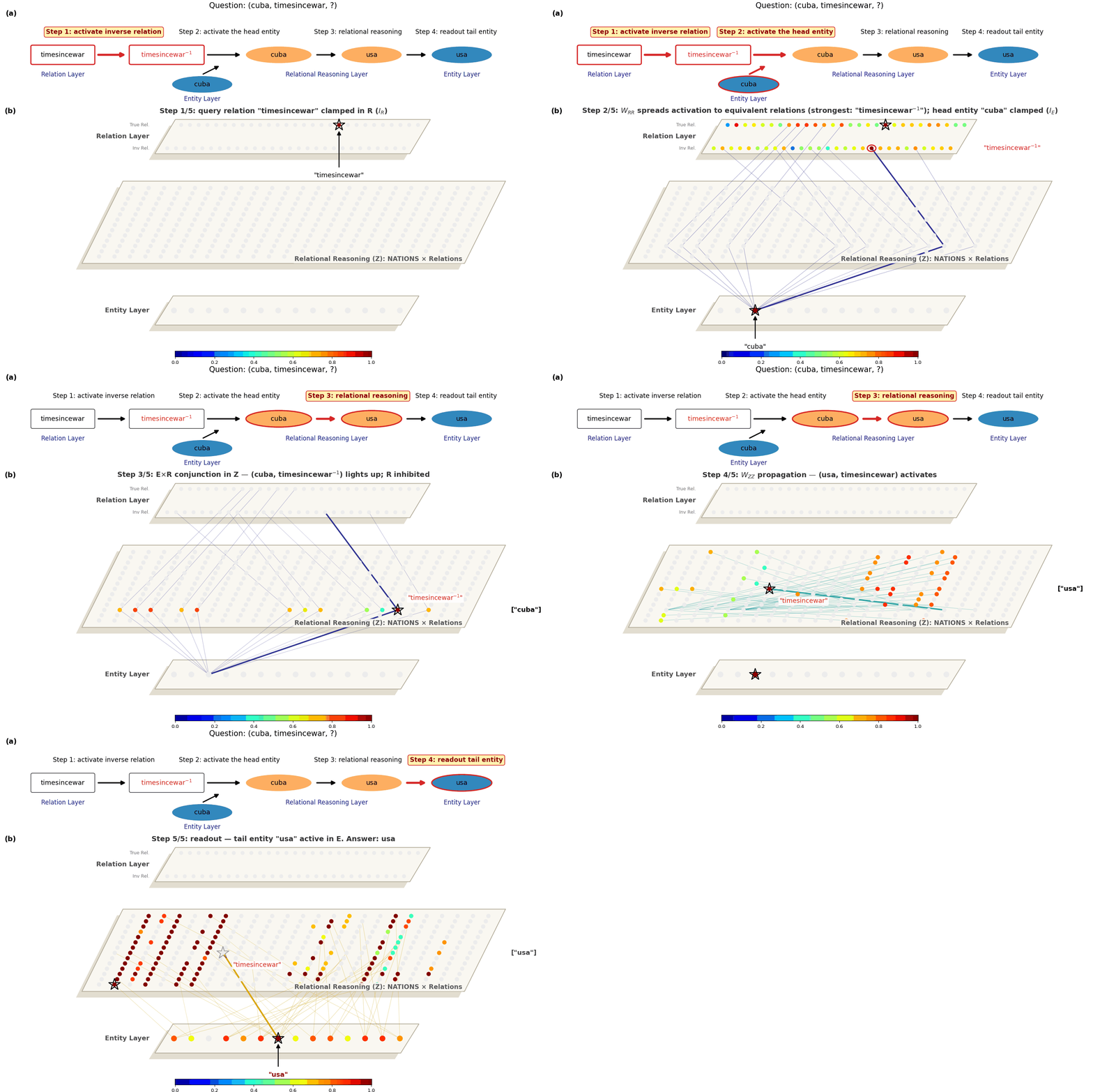
A brain-inspired architecture that preserves relational structure in layered network connectivity, achieving competitive accuracy with human-readable reasoning traces over knowledge graphs.
Project page
Interactive blog
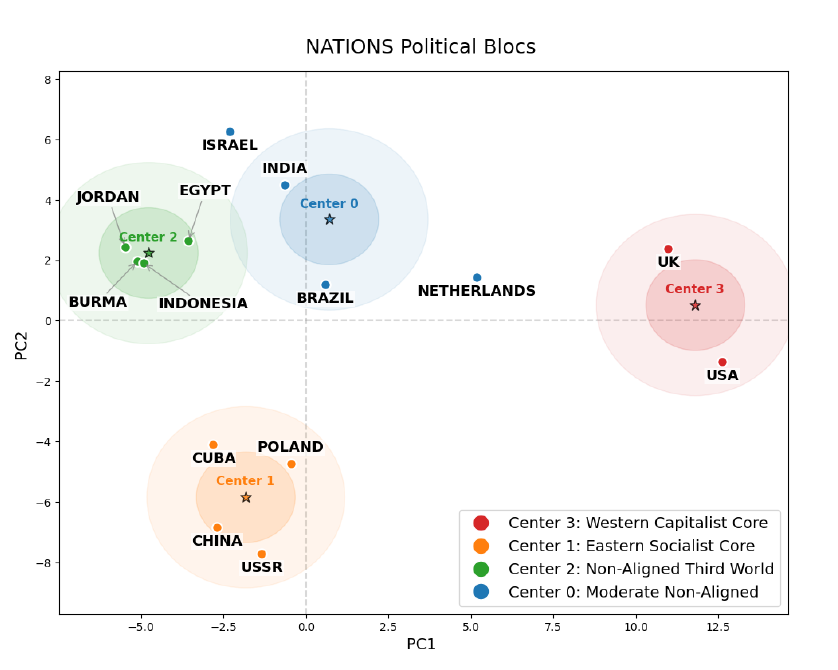
NSR integrates hierarchical representation with relation-driven state transitions and Hebbian-type learning. Beyond benchmark accuracy, its inference dynamics natively expose human-readable reasoning traces, and the model spontaneously discovers interpretable latent structure — e.g., projecting nations by their learned relational connections yields four clusters that correspond to Cold-War political blocs.
OpenReview: 5 / 4 / 4 · Average rating 4.33 · Decision: Accept (Poster)
Published - JCR Q1Multimodal Fusion Network for Microdisplacement Measurement via Michelson Interferometer
Optics and Laser Technology 201 (2026) 115225 (CAS Zone 2 Top Optics Journal).
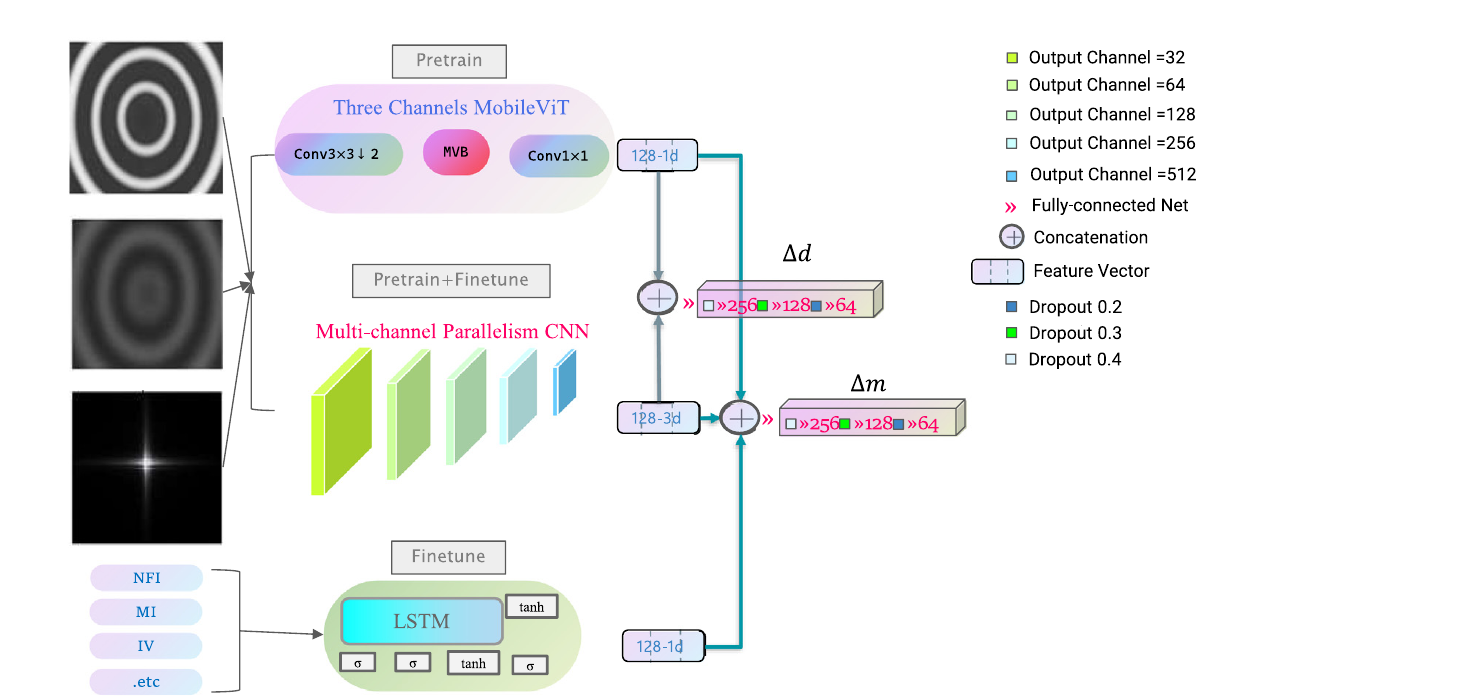
Developed a dual-head multimodal fusion network (MFN) to resolve lambda/2 phase ambiguity and achieve nanoscale displacement inference.
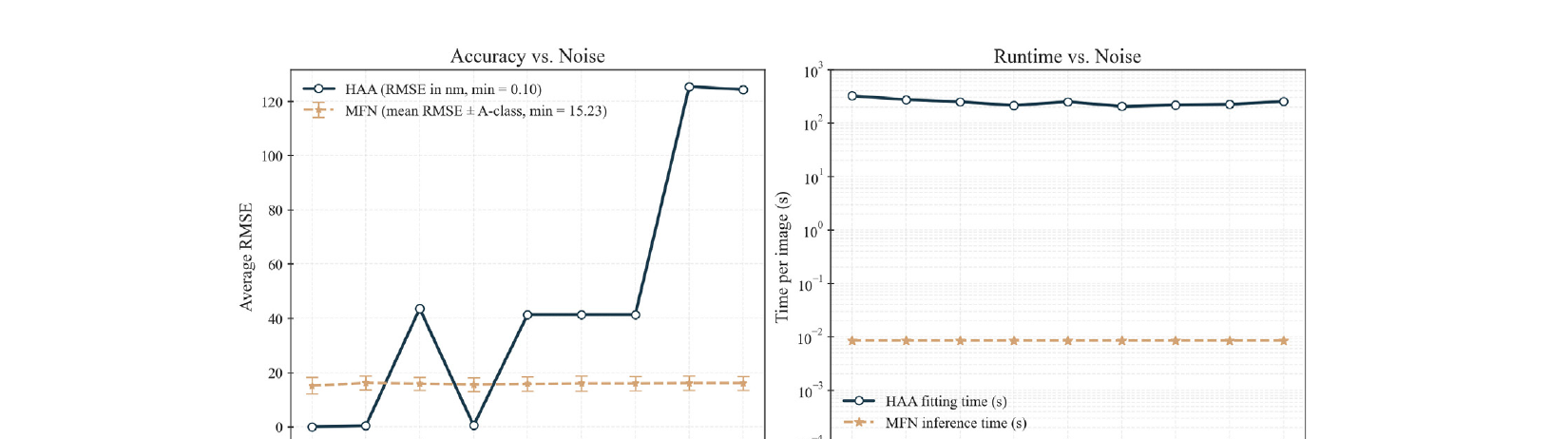
MFN fuses three interferogram channels (raw / differential / FFT) through a MobileViT-CNN hybrid backbone with an LSTM temporal encoder, then splits into a displacement regression head and an interference-order classification head. It maintains stable precision under severe noise while running over four orders of magnitude faster than the traditional HAA fitting pipeline.